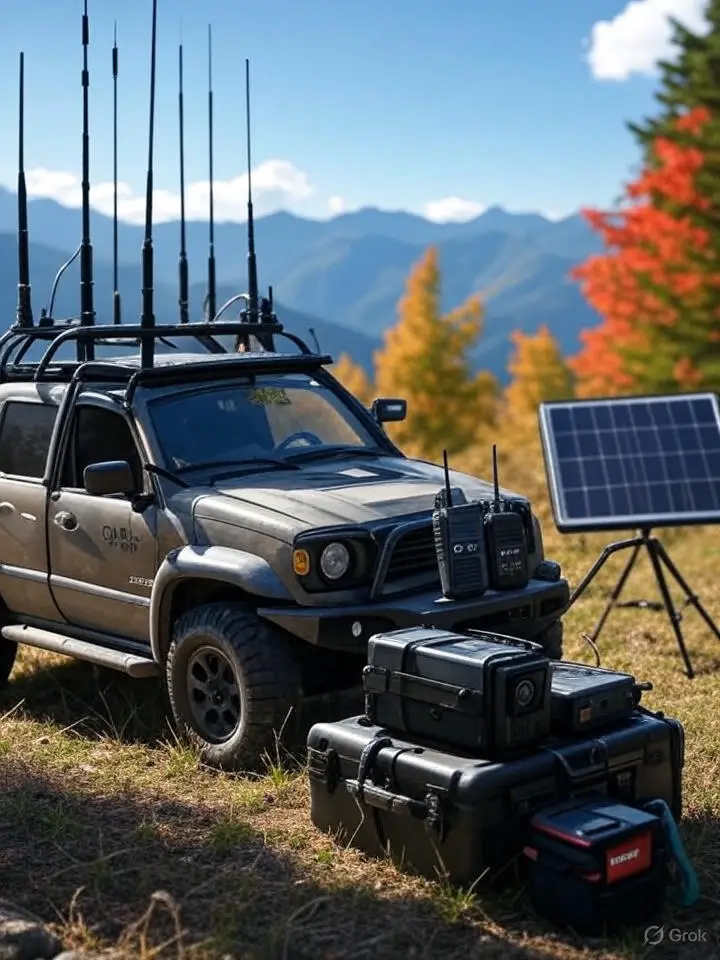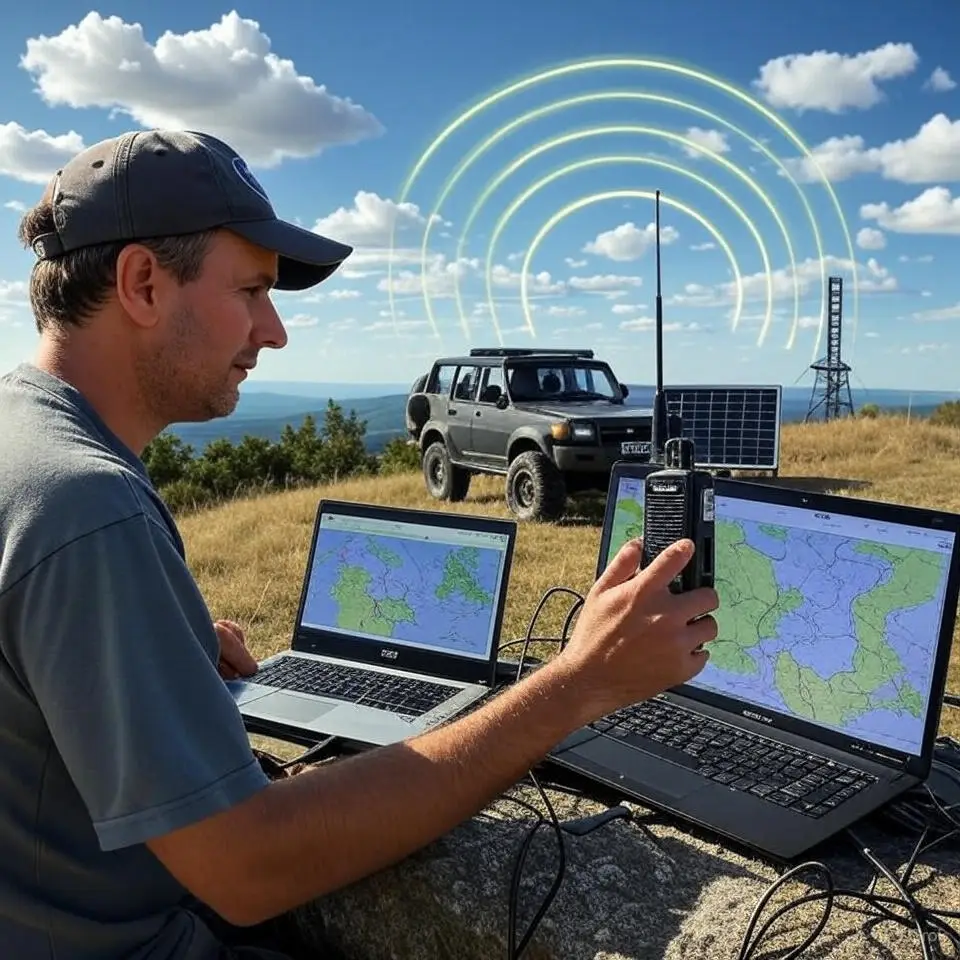
For portable HF operators chasing park activations, summit contacts, or simply wanting a grab-and-go antenna that doesn’t require trees, the Radioddity HF-009 offers an intriguing proposition: a self-supporting quarter-wave vertical covering 60 meters through 6 meters in a 2-kilogram package. The complete field kit includes everything needed for deployment—ground spike, mast sections, loading coil, telescopic whip, radials, and feedline.
But can a compact loaded vertical actually deliver usable performance across that ambitious frequency range? After examining the specifications, user manual, and field reports from portable operators, here’s what you need to know before adding the HF-009 to your go-kit.
Affiliate Disclosure:
“Just so you know, some of the links on this page are affiliate links. This means if you decide to make a purchase through one of those links, I might earn a small commission at no extra cost to you. Your support helps keep this content going—thank you!”
What the HF-009 Actually Is
At its core, the HF-009 is a center-loaded quarter-wave vertical antenna. That means it uses a sliding inductance coil mounted partway up the mast to electrically lengthen a physically short antenna, allowing it to resonate on frequencies where a true quarter-wave would be impractically tall.
For reference, a quarter-wave vertical on 40 meters would stand over 10 meters (33 feet) tall. The HF-009 achieves coverage of that band—and lower—with a total height of approximately 3.7 meters (about 12 feet). The trade-off, as with all electrically shortened antennas, involves some efficiency loss compared to full-size designs. More on that later.
The antenna covers approximately 5-50 MHz, spanning the 60-meter, 40-meter, 30-meter, 20-meter, 17-meter, 15-meter, 12-meter, 10-meter, and 6-meter amateur bands. Tuning works differently depending on frequency: for bands at or below 18 MHz, you adjust the sliding coil position; for bands above 18 MHz, you adjust the telescopic whip length instead.
Power handling is rated at 100 watts CW and 150 watts PEP SSB—sufficient for virtually all portable transceivers and compatible with most 100-watt-class HF radios like the Icom IC-705, Yaesu FT-891, or Xiegu G90.
What’s in the Box
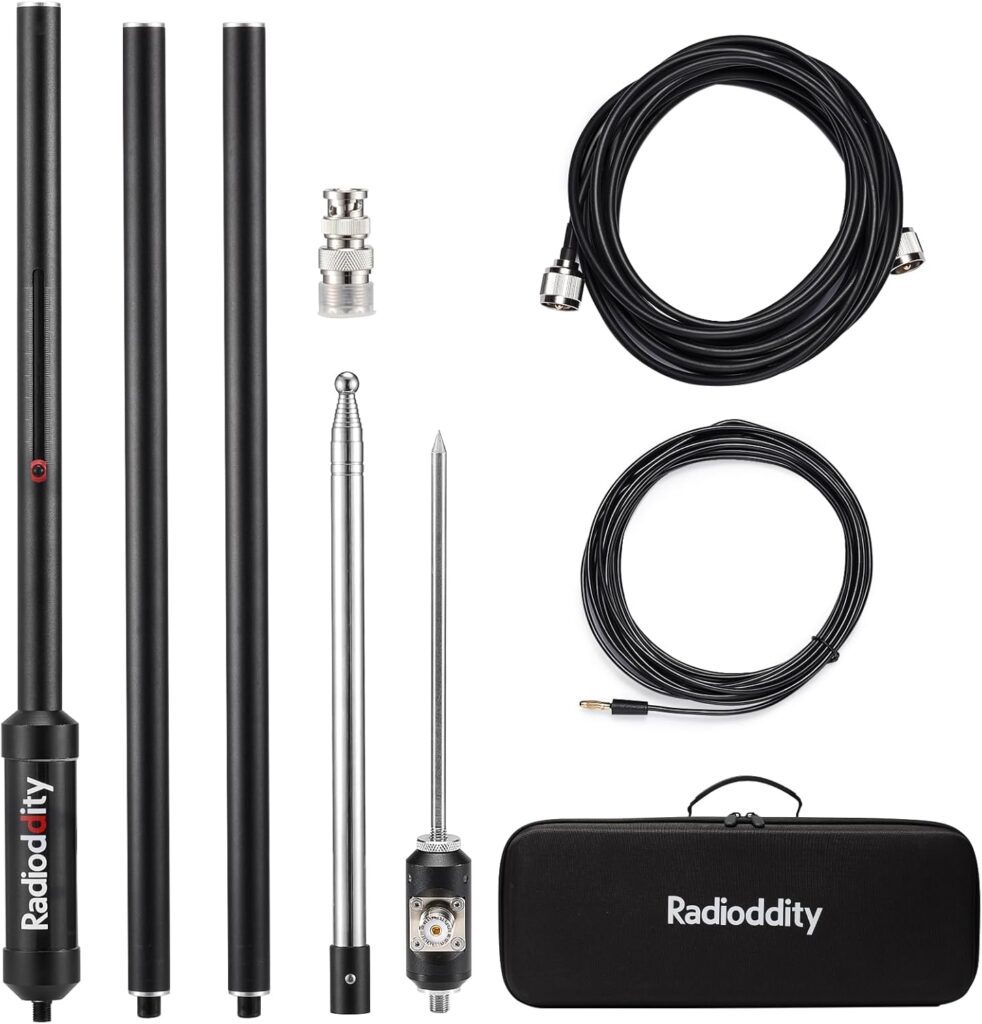
Radioddity packages the HF-009 as a complete field kit requiring no additional purchases for basic operation:
Antenna components:
Ground spike with SO-239 connector base
Two aluminum alloy extension mast sections
Sliding adjustable inductance coil (the tuning element)
Stainless steel telescopic whip (extends to approximately 2.3 meters)
Ground system:
Three 5-meter radial wires with banana plug connectors
Feedline and adapters:
5 meters of 50-ohm coaxial cable with PL-259 connectors
BNC-male to SO-239 adapter (for radios with BNC antenna ports)
Transport:
Padded carry bag (approximately 48.5 × 19.5 × 9.5 cm)
Total kit weight runs about 2 kilograms, with the antenna itself weighing roughly 1 kilogram. The aluminum and stainless steel construction includes anti-corrosion treatment, though Radioddity notes the antenna isn’t intended for permanent outdoor installation.
Field Setup: Simpler Than It Looks
Despite the multi-component design, the HF-009 assembles quickly once you’ve done it a few times. The basic sequence:
Drive the ground spike into soil at your operating location. The spike provides both mechanical support and the feedpoint connection.
Stack the two mast sections onto the spike base, creating the lower portion of the vertical element.
Attach the sliding loading coil to the top of the mast sections.
Mount the telescopic whip to the top of the coil.
Deploy the three radials by plugging them into the banana jacks on the spike base and fanning them out roughly 120 degrees apart on the ground.
Connect the coax from your radio to the SO-239 on the spike base.
Total assembly time runs 5-10 minutes with practice—competitive with end-fed half-wave antennas and considerably faster than setting up wire antennas requiring supports.
Tuning: The Learning Curve
Here’s where the HF-009 requires some operator investment. Unlike a resonant dipole or linked antenna system that’s pre-cut for specific bands, the HF-009 demands active tuning each time you change frequency ranges.
For frequencies at or below 18 MHz (60m through 17m), tuning involves sliding the loading coil up or down the mast until your antenna analyzer shows acceptable SWR. The coil position determines how much inductance is in the circuit, which controls the resonant frequency.
For frequencies above 18 MHz (15m through 6m), the coil position matters less; instead, you adjust the telescopic whip length to find resonance.
Radioddity claims SWR of 1.0-1.5:1 when properly tuned, and field tests generally confirm this is achievable with patience. One detailed review measured SWR ranging from 1.07 to 2.3 across different bands, with 10 meters proving the most challenging to optimize below 2:1 without extra effort.
Pro tip from experienced users: Mark the coil position for each band after your initial tuning session. Once you’ve dialed in the sweet spots, subsequent band changes become much faster—slide to the mark, verify with your analyzer, and you’re transmitting.
The center-mounted coil placement actually helps here compared to base-loaded designs. You’re adjusting the coil at roughly chest height rather than reaching down to ground level, making iterative tuning more ergonomic during extended portable sessions.
Real-World Performance Expectations
Let’s be direct about what the HF-009 can and cannot do.
Where it performs well:
The antenna works genuinely well on 20 meters and above, where the physical height represents a reasonable fraction of a quarter wavelength. Portable operators report solid POTA (Parks on the Air) and SOTA (Summits on the Air) activations on these bands, making contacts across hundreds or thousands of miles with 10-50 watts.
The self-supporting design eliminates the need for trees, fishing poles, or other supports—a significant advantage in open terrain, beaches, or above treeline on summits. Drive the spike, assemble the mast, and you’re radiating.
Where physics limits performance:
On 40 meters and especially 60 meters, the HF-009 faces the fundamental challenge of all short loaded verticals: a physically small antenna on low frequencies sacrifices efficiency. The radiation resistance drops, losses in the loading coil increase, and the antenna becomes more sensitive to ground conditions and radial effectiveness.
This doesn’t mean the antenna won’t work on 40 or 60 meters—it will, and operators do make contacts. But expect reduced performance compared to full-size verticals, proper dipoles, or end-fed half-waves on those bands. If low-band DX is your primary goal, a different antenna design may serve you better.
The three included 5-meter radials represent another compromise. While adequate for portable operation, serious low-band work typically benefits from more radials or longer radials. The HF-009’s radial system is optimized for portability rather than maximum efficiency.
Ideal Use Cases
The HF-009 shines in specific scenarios:
POTA and SOTA activations where setup speed, self-supporting operation, and multi-band flexibility matter more than squeezing out the last decibel of performance. The ability to work 20, 17, 15, and 10 meters from a single antenna without changing hardware is genuinely useful when band conditions shift during an activation.
Camping and travel where you want HF capability without hauling a full antenna farm. The compact carry bag fits in a backpack or vehicle, and the complete kit means you’re not hunting for guy lines, mast supports, or antenna tuners.
Emergency and backup communications where rapid deployment trumps optimization. The HF-009 goes from bag to on-air faster than most wire antennas and doesn’t depend on environmental supports that may not exist at your operating location.
Small-space temporary setups in backyards, hotel parking lots, or other locations where permanent antennas aren’t practical and you need something more capable than a mobile whip.
Design Trade-Offs Worth Noting
The sliding coil design, while convenient for tuning, offers less granular adjustment than some base-loaded verticals with continuous-contact collar systems. Users note this discrete-step tuning can make finding the absolute minimum SWR slightly more challenging, though the practical difference is minimal for most operators.
Mechanical stability depends on solid ground spike insertion. Soft soil, sand, or rocky ground can affect both physical stability and electrical performance. In challenging ground conditions, consider carrying a few tent stakes to anchor the radials and stabilize the base.
The manufacturer explicitly warns against permanent outdoor installation and recommends taking the antenna down during storms. This is a portable antenna designed for portable use—treat it as field gear rather than a permanent station antenna.
How It Compares
Versus end-fed half-wave antennas: The HF-009 is self-supporting and faster to deploy but typically less efficient on lower bands. EFHWs need a support (tree, mast, fishing pole) but offer better low-band performance when properly installed.
Versus base-loaded mobile whips on tripods: Similar concept, but the HF-009’s center loading and taller profile generally provide better performance. Mobile whips are often more compact but require more compromise on efficiency.
Versus Wolf River Coils and similar systems: Those collar-tuned base-loaded verticals offer finer tuning resolution but place the adjustment point at ground level. The HF-009’s mid-mast coil is more ergonomic for field tuning. Build quality and efficiency comparisons depend on specific models.
Versus random wire with tuner: A random wire and ATU can cover more frequencies with less fussing, but requires supports and doesn’t offer the self-supporting vertical’s omnidirectional pattern or independence from trees.
The Bottom Line
The Radioddity HF-009 delivers on its core promise: a genuinely portable, self-supporting HF vertical that covers the major amateur bands in a package light enough for backpacking and complete enough for immediate deployment. The ~$130-150 price point (check current Amazon pricing) undercuts many comparable antennas while including feedline, radials, and carrying case.
It won’t replace a proper home station antenna, and operators focused on 40 or 60 meters should temper expectations about low-band efficiency. But for portable operators who prioritize setup speed, multi-band flexibility, and freedom from environmental supports, the HF-009 represents a practical tool that earns its place in the go-kit.
If you’re activating parks, chasing summits, or simply want HF capability that fits in a backpack and deploys in minutes, the HF-009 deserves serious consideration. Mark those coil positions, bring your antenna analyzer, and enjoy making contacts from places most operators never reach.
The Radioddity HF-009 is available on Amazon and direct from Radioddity. An amateur radio license is required for transmission on HF frequencies.