In an era where electronic communications dominate every aspect of modern life, citizens find themselves at the intersection of two powerful forces: the sophisticated signals intelligence (SIGINT) capabilities that nations employ for security and the proliferating electronic threats that target individuals daily. While government agencies intercept foreign signals to protect national interests, ordinary Americans face their own electronic warfare from cybercriminals who steal approximately $10.3 billion annually through digital schemes.
This comprehensive guide examines both sides of the electronic intelligence landscape—the regulated world of state-sponsored signals intelligence and the chaotic realm of criminal electronic threats targeting citizens. It also explores how affordable Software-Defined Radio (SDR) technology like HackRF One, RTL-SDR dongles, and other platforms democratize signal analysis capabilities, allowing citizens to better understand the electromagnetic environment around them while developing practical skills for the digital age.
Affiliate Disclosure:
“Just so you know, some of the links on this page are affiliate links. This means if you decide to make a purchase through one of those links, I might earn a small commission at no extra cost to you. Your support helps keep this content going—thank you!”
The Dual Nature of Electronic Intelligence
At its core, signals intelligence involves the collection and analysis of electromagnetic emissions—everything from radio communications to radar signals—to gather information about foreign activities and capabilities. The National Security Agency (NSA), designated as America’s lead SIGINT organization, describes this mission as collecting, processing, and analyzing foreign signals to provide intelligence for policymakers and military forces.
Yet while NSA analysts track foreign threats through electronic signatures using sophisticated equipment worth millions of dollars, citizens can now explore similar concepts using Software-Defined Radio devices costing as little as $50 for an RTL-SDR dongle or $350 for the more capable HackRF One. These devices transform computers into powerful spectrum analyzers and signal decoders, democratizing capabilities that once required rooms full of specialized equipment.
Think of the electronic spectrum as a vast battlefield where multiple conflicts occur simultaneously. Nation-states engage in sophisticated intelligence operations governed by international law and domestic oversight. Meanwhile, cybercriminals launch ransomware attacks, identity thieves create synthetic identities from stolen data fragments, and surveillance capitalists harvest personal information for profit. Citizens exist at the center of this multidimensional conflict, generating the signals that all parties seek to exploit—but now with SDR technology, they can also observe and understand these signals themselves.
SDR Technology: Democratizing Signal Analysis
Software-Defined Radio represents a fundamental shift in how radio systems work. Traditional radios use hardware components—capacitors, inductors, crystals—to tune and demodulate specific frequencies. SDR devices like HackRF One, USRP (Universal Software Radio Peripheral), and LimeSDR replace these fixed components with software, allowing a single device to receive (and sometimes transmit) across vast frequency ranges using different modulation schemes.

Entry-Level SDR: RTL-SDR
The RTL-SDR, originally a $25 USB TV tuner dongle, revolutionized amateur signal analysis when hackers discovered it could tune from 24 MHz to 1.7 GHz. Despite its modest price, RTL-SDR enables citizens to:
Monitor aircraft transponders (ADS-B) and track flights in real-time
Decode weather satellite images from NOAA spacecraft
Analyze local radio frequency usage and identify interference sources
Receive and decode digital modes like APRS, POCSAG pagers, and P25 radio systems
Study IoT device emissions and understand their vulnerabilities
This entry point into SDR requires only basic software like SDR#, GQRX, or CubicSDR, making signal analysis accessible to anyone with curiosity and a computer. Citizens can observe firsthand how their smart meters transmit data, how key fobs communicate with vehicles, and what signals permeate their environment.
Mid-Range Capability: HackRF One
The HackRF One, designed by Michael Ossmann and manufactured by Great Scott Gadgets, extends SDR capabilities significantly. Operating from 1 MHz to 6 GHz with up to 20 MHz of bandwidth, HackRF One can both receive and transmit signals (half-duplex). This $300 open-source platform enables:
Spectrum analysis across nearly the entire range used by consumer devices
Reverse engineering of proprietary protocols used by commercial devices
Testing of radio systems and identification of vulnerabilities
Development of custom radio applications and security research
Educational exploration of radio frequency concepts and digital signal processing
The HackRF’s transmit capability requires careful consideration of legal restrictions. While receiving signals is generally legal, transmission is heavily regulated. Users must ensure any transmissions comply with FCC regulations, typically requiring an amateur radio license for experimental work and strict adherence to power limits and frequency allocations.
.
The Ultimate Portable Platform: PortaPack H4M + HackRF One Kit
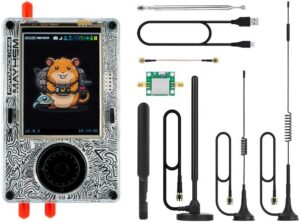
While the HackRF One provides impressive capabilities when tethered to a computer, the PortaPack H4M transforms it into a completely autonomous, handheld signals intelligence platform that fits in your pocket. This evolution represents the most significant advancement in citizen-accessible SDR technology, putting professional-grade RF analysis and transmission capabilities into a device no larger than a smartphone.
The latest 2024-2025 generation PortaPack H4M, typically sold as a complete bundle with HackRF R10 board and pre-flashed Mayhem firmware for $300-400, eliminates the laptop dependency that has historically limited field operations. The integrated 3.2-inch touchscreen provides full control over the HackRF’s 1 MHz to 6 GHz frequency range with 20 MHz of instantaneous bandwidth, while the internal 2500-3000 mAh rechargeable battery delivers hours of untethered operation. The rugged ABS case protects sophisticated electronics that include USB-C charging, a proper power button, microSD slot for capturing gigabytes of signal data, built-in speaker and microphone, headphone jack, and even a real-time clock for timestamping captures.
The Mayhem firmware transforms this hardware into a Swiss Army knife of RF capabilities. Citizens can conduct comprehensive spectrum analysis with waterfall displays showing real-time activity across any frequency band, instantly identifying active transmitters, sources of interference, or suspicious signals in their environment. The capture and replay functionality enables testing of garage door openers, car key fobs, and other fixed-code systems to understand their vulnerabilities—critical knowledge for assessing whether your own devices are susceptible to replay attacks.
For transportation awareness, integrated ADS-B decoding tracks aircraft in real-time without internet connectivity, while AIS reception monitors maritime vessel movements. These capabilities prove invaluable during emergencies when understanding nearby transportation assets could be life-saving. The POCSAG pager decoder reveals how much sensitive information still transmits unencrypted through legacy systems, often including medical dispatches and infrastructure alerts that demonstrate the importance of proper encryption.
The platform’s analog and digital voice reception capabilities span multiple protocols including DMR, P25, and conventional FM, allowing citizens to monitor public safety communications during emergencies (where legal) and understand how their local first responders coordinate. The device can even transmit analog FM audio when properly licensed, enabling emergency communications when cellular networks fail.
Perhaps most relevant for personal security, the PortaPack H4M excels at detecting and analyzing potential surveillance threats. Its portability enables systematic counter-surveillance sweeps of vehicles, hotel rooms, or offices without arousing suspicion. The device can identify hidden cameras transmitting video, audio bugs, GPS trackers, and even cellular IMSI catchers (Stingrays) operating in the area. The IQ recording capability captures raw signal data to the microSD card for later analysis with GNU Radio or Universal Radio Hacker, enabling detailed reverse engineering of unknown signals.
The Mayhem firmware includes dozens of specialized applications that would typically require expensive test equipment. WiFi and Bluetooth analysis tools reveal device presence and potential vulnerabilities. The signal generator creates test patterns for calibrating equipment or testing shielding effectiveness. Frequency scanner modes automatically identify active channels across specified ranges, building profiles of local RF environments. Even GPS simulation capabilities exist, though these require extreme caution due to legal implications and potential for disrupting critical services.
Citizens investigating IoT security particularly benefit from the PortaPack’s field portability. Walking through a smart home with the device immediately reveals which devices transmit constantly versus periodically, what protocols they employ, and whether communications are encrypted. This real-time feedback helps identify chatty devices that might be sharing more information than expected or using insecure protocols vulnerable to interception.
The expandability through the GPIO/I2C header opens remarkable possibilities for community innovation. Enthusiasts are developing add-on boards featuring ESP32 modules for integrated WiFi/Bluetooth analysis, GPS receivers for automatic position logging during war-driving sessions, external amplifiers for extended range (within legal limits), specialized filters for specific frequency bands, and even AI coprocessors for automatic signal classification. Some experimenters link multiple units for synchronized captures enabling TDOA (Time Difference of Arrival) geolocation of transmitters.
However, this power demands extraordinary responsibility. The PortaPack H4M’s transmission capabilities can interfere with critical communications, disrupt emergency services, or violate numerous federal laws if used carelessly. Any transmission requires appropriate licensing—typically an amateur radio license at minimum—and strict adherence to power limits and frequency allocations. The device’s jamming capabilities, while technically impressive, are illegal to use in virtually all circumstances and could result in substantial fines or imprisonment. GPS spoofing, even for testing, risks disrupting aviation and emergency services with potentially catastrophic consequences.
Responsible users employ the PortaPack H4M primarily for reception and analysis, using transmission capabilities only in controlled environments with proper authorization. The device excels at education, teaching practical RF concepts through hands-on experimentation. Security professionals use it for authorized penetration testing, identifying vulnerabilities before malicious actors exploit them. Emergency preparedness enthusiasts value its ability to monitor multiple communication modes when infrastructure fails.
The PortaPack H4M represents the democratization of capabilities once exclusive to intelligence agencies and specialized contractors. For under $400, citizens gain a pocket-sized platform for understanding the invisible RF world surrounding them. This isn’t about becoming a spy or hacker—it’s about informed awareness in an age where electronic threats proliferate while most people remain oblivious to the signals constantly transmitted by and around them.
When combined with proper training and ethical use, the PortaPack H4M becomes a powerful tool for personal electronic security. Citizens can verify their car’s key fob uses rolling codes resistant to replay attacks, confirm their smart home devices employ proper encryption, detect potential surveillance devices, and understand which of their gadgets leak information through unintended emissions. This practical knowledge, gained through direct observation rather than theoretical study, enables informed decisions about which technologies to trust and which to avoid.
Professional-Grade SDR: USRP and LimeSDR
For serious researchers and advanced hobbyists, Ettus Research’s USRP series and LimeSDR provide laboratory-grade capabilities. These devices, ranging from $700 to several thousand dollars, offer:
Multiple synchronized channels for MIMO applications
Higher dynamic range and sensitivity than consumer SDRs
Wider bandwidth capture (up to 160 MHz on some models)
GPS-disciplined oscillators for precise frequency accuracy
Full-duplex operation for simultaneous transmit and receive
These platforms support advanced applications like cellular network analysis (with proper authorization), radar experimentation, and development of custom communication protocols. Universities use them for telecommunications research, while security professionals employ them for vulnerability assessment of wireless systems.
The Architecture of Signals Intelligence: Professional vs. Amateur
Understanding how professional SIGINT operates compared to citizen SDR capabilities reveals both the power and limitations of consumer technology in the signals intelligence domain.
Communications Intelligence (COMINT) with SDR
While NSA COMINT operations employ massive antenna farms and supercomputers to process global communications, citizens can use SDR to understand local signal environments and protect themselves from electronic threats.
With tools like GNU Radio, citizens can build signal processing flowgraphs that:
Decode unencrypted digital radio protocols to understand how emergency services communicate
Analyze WiFi and Bluetooth emissions to identify potential security vulnerabilities
Monitor baby monitors, wireless cameras, and other devices that might compromise privacy
Detect hidden transmitters or surveillance devices in sensitive areas
Popular software packages extend SDR capabilities for COMINT-style analysis:
Universal Radio Hacker (URH): Designed for investigating unknown wireless protocols
Dragon OS: A complete Linux distribution with pre-installed SDR and signal analysis tools
GR-GSM: GNU Radio blocks for analyzing GSM cellular signals (receive only)
DSD+: Digital speech decoder for various radio systems
Citizens must understand that while these tools can receive and analyze many signals, modern encrypted communications remain secure. SDR can identify that encrypted communications are occurring and analyze their patterns (traffic analysis), but cannot break properly implemented encryption—the same limitation professional SIGINT agencies face.
Electronic Intelligence (ELINT) Applications
Consumer SDR devices excel at ELINT-style applications, allowing citizens to:
Characterize Electronic Emissions: Using software like QSpectrumAnalyzer with HackRF, users can create waterfall displays showing signal characteristics over time. This reveals patterns in smart home devices, identifies sources of radio frequency interference, and detects anomalous signals in the environment.
Radio Frequency Surveying: SDR enables systematic surveys of local RF environments. Citizens can identify:
Unauthorized transmitters in sensitive areas
Sources of interference affecting WiFi or cellular service
Hidden cameras or audio surveillance devices
Malfunctioning equipment generating spurious emissions
IoT Security Assessment: With SDR, citizens can analyze their IoT devices’ RF emissions, understanding:
How frequently devices transmit data
What protocols they use (and whether they’re encrypted)
Potential vulnerabilities in device communications
Whether devices communicate beyond their stated functions
Signal Analysis Tools and Techniques
Modern SDR software provides sophisticated analysis capabilities once exclusive to intelligence agencies:
Spectrum Analyzers: Software like hackrf_sweep turns HackRF into a spectrum analyzer covering its entire 1 MHz to 6 GHz range, identifying active frequencies and signal strengths. This helps citizens understand spectrum usage in their area and identify potential security concerns.
Protocol Decoders: Tools like Inspectrum and Universal Radio Hacker allow visual analysis of digital signals, revealing modulation types, symbol rates, and packet structures. Citizens can reverse-engineer proprietary protocols used by commercial devices, understanding how their data is transmitted.
Signal Classification: Machine learning frameworks like RFLearn use artificial intelligence to automatically classify signal types, distinguishing between WiFi, Bluetooth, cellular, and other protocols. This automation helps citizens quickly identify signals of interest without deep technical knowledge.
Legal Frameworks and Ethical SDR Use
While SDR technology provides powerful capabilities, citizens must understand the legal and ethical boundaries governing its use. The Communications Act of 1934 and Electronic Communications Privacy Act establish fundamental restrictions on intercepting communications.
Reception vs. Transmission
In the United States, receiving radio signals is generally legal with specific exceptions:
Cellular phone conversations are illegal to intentionally intercept
Encrypted signals can be received but not decrypted without authorization
Cordless phone conversations (on certain frequencies) have privacy protections
Transmission requires proper licensing:
Amateur radio license for experimental transmissions on ham bands
Part 15 compliance for unlicensed intentional radiators
Professional licenses for commercial operations
Responsible Disclosure
Citizens discovering vulnerabilities through SDR analysis should follow responsible disclosure practices:
Document findings carefully without exploiting vulnerabilities
Notify manufacturers through proper channels
Allow reasonable time for patches before public disclosure
Never use discoveries for unauthorized access or harm
Privacy Considerations
While analyzing signals, citizens may inadvertently intercept neighbors’ communications. Ethical SDR use requires:
Focusing on one’s own devices and authorized targets
Not recording or sharing intercepted private communications
Using findings to improve security, not exploit vulnerabilities
Respecting others’ privacy while investigating one’s own security
Practical SDR Applications for Personal Security
Citizens can employ SDR technology to enhance their electronic security through various practical applications:
Home RF Security Audits
Using RTL-SDR or HackRF, conduct regular audits of your home’s RF environment:
Baseline Establishment: Record normal RF activity patterns when all known devices are operating. This baseline helps identify anomalous signals that might indicate surveillance devices or compromised equipment.
Device Inventory: Catalog all RF-emitting devices, documenting their operating frequencies, transmission patterns, and protocols. This inventory helps identify unauthorized devices and understand potential attack vectors.
Vulnerability Assessment: Analyze how your devices communicate, identifying those using unencrypted protocols or weak security. Prioritize replacing or securing vulnerable devices.
Vehicle Security Analysis
Modern vehicles contain numerous RF systems susceptible to attack. SDR analysis reveals:
Key fob frequencies and modulation schemes (important for understanding replay attack risks)
Tire pressure monitoring system vulnerabilities
Aftermarket device emissions that might track vehicle location
Potential jamming or spoofing threats to GPS navigation
Counter-Surveillance Applications
While not paranoid, security-conscious citizens can use SDR for counter-surveillance:
Bug Detection: Systematic RF sweeps using SDR can detect:
Hidden wireless cameras transmitting video
Audio surveillance devices
GPS trackers on vehicles
Cellular IMSI catchers (Stingrays) in the area
Signal Geolocation: Using multiple SDR receivers or a single mobile unit, citizens can triangulate signal sources through:
Power-based distance estimation
Time Difference of Arrival (TDOA) techniques
Doppler shift analysis for moving transmitters
Advanced SDR Projects for Citizens
Beyond basic reception and analysis, SDR enables sophisticated projects that deepen understanding of electronic intelligence:
Building a Passive Radar System
Using HackRF or USRP, citizens can create passive radar systems that detect aircraft and vehicles without transmitting signals. These systems use existing transmissions (FM radio, TV broadcasts) as illumination sources, analyzing reflections to track objects. This demonstrates ELINT principles while remaining completely passive and legal.
Mesh Network Development
SDR platforms enable experimentation with resilient mesh networks that operate independently of traditional infrastructure. Projects like ATAK (Android Team Awareness Kit) with SDR backends create situational awareness tools for emergency response, demonstrating how distributed RF systems enhance communications resilience.
Radio Astronomy and Natural RF Phenomena
SDR opens access to natural radio emissions from space and Earth:
Jupiter’s radio storms
Meteor scatter communications
Solar radio bursts
Lightning-generated whistlers
These projects develop signal processing skills while exploring natural RF phenomena that professional SIGINT systems must filter out.
Protecting Against Electronic Threats with SDR Knowledge
Understanding SDR and signals intelligence helps citizens implement informed defense strategies against electronic threats:
Detecting Compromised Devices
Regular SDR monitoring can reveal when devices behave abnormally:
IoT devices transmitting outside expected patterns
Increased RF activity suggesting malware infection
Unexpected protocols indicating device compromise
Understanding Attack Vectors
SDR analysis reveals how attackers might exploit RF systems:
Replay attacks against fixed-code systems
Jamming vulnerabilities in critical devices
Side-channel emissions leaking sensitive information
This knowledge informs better security practices and device choices.
Developing RF Hygiene
Like cyber hygiene, RF hygiene involves practices that reduce electronic attack surfaces:
Disabling unnecessary wireless interfaces
Using RF-shielded bags for sensitive devices
Implementing time-based RF policies (wireless off at night)
Choosing devices with better RF security implementations
Future Implications: SDR and Emerging Threats
As SDR technology advances and becomes more accessible, both opportunities and threats evolve:
Artificial Intelligence Integration
AI-powered SDR systems will automatically:
Classify and track all signals in an environment
Detect anomalies suggesting security threats
Optimize reception and decoding in real-time
Generate fingerprints for device identification
Citizens with AI-enabled SDR will have unprecedented awareness of their RF environment, while attackers will use similar capabilities for automated target identification and exploitation.
Quantum-Resistant Communications
As quantum computing threatens current encryption, SDR will play a crucial role in transitioning to quantum-resistant algorithms. Citizens will need to understand:
Which devices require updates for quantum resistance
How to verify proper implementation of new protocols
Methods for detecting quantum-vulnerable legacy systems
Cognitive Radio and Dynamic Spectrum Access
Future SDR systems will negotiate spectrum access dynamically, sharing frequencies based on real-time needs. This cognitive radio approach requires citizens to understand:
How automated spectrum management affects privacy
Security implications of dynamic frequency allocation
Protection against cognitive radio exploitation
Conclusion: Empowered Citizens in the Electronic Age
The convergence of professional signals intelligence capabilities, criminal electronic threats, and democratized SDR technology creates a complex but navigable security landscape. Citizens equipped with SDR devices and knowledge can transition from passive targets to active participants in their electronic security.
Understanding SIGINT principles through hands-on SDR experimentation provides practical benefits:
Recognition of surveillance indicators
Identification of vulnerable devices
Appreciation for encryption importance
Awareness of RF attack vectors
The $25 RTL-SDR dongle, $300 HackRF One, or the fully portable $400 PortaPack H4M kit won’t match NSA capabilities, but they provide sufficient capability for citizens to understand and defend against the electronic threats they actually face. More importantly, SDR education develops critical thinking about wireless security that no amount of theoretical study can match.
As electronic threats proliferate and wireless devices permeate every aspect of life, SDR literacy becomes as important as computer literacy. Citizens who understand how signals intelligence works—through practical experience with SDR—can make informed decisions about their digital activities, implement appropriate security measures, and participate meaningfully in democratic debates about surveillance, privacy, and security.
The electromagnetic spectrum surrounding us tells countless stories—from nation-state intelligence operations to criminal schemes to the routine communications of daily life. With SDR technology, citizens can finally read these stories for themselves, transforming from passive subjects of electronic intelligence to informed participants who understand both the threats they face and the tools available to defend against them. In the interconnected digital world, this combination of knowledge, technology, and vigilance provides the best defense against both sophisticated intelligence operations and common criminal threats.