Everything a licensed amateur needs to know about the radio that changed what twenty-five dollars can do
Disclosure: CommsGearReport.com participates in the Amazon Associates program and other affiliate programs. If you purchase gear through links on this page, we may earn a commission at no additional cost to you. Affiliate relationships never influence our technical assessments or recommendations.
What You’re Actually Buying
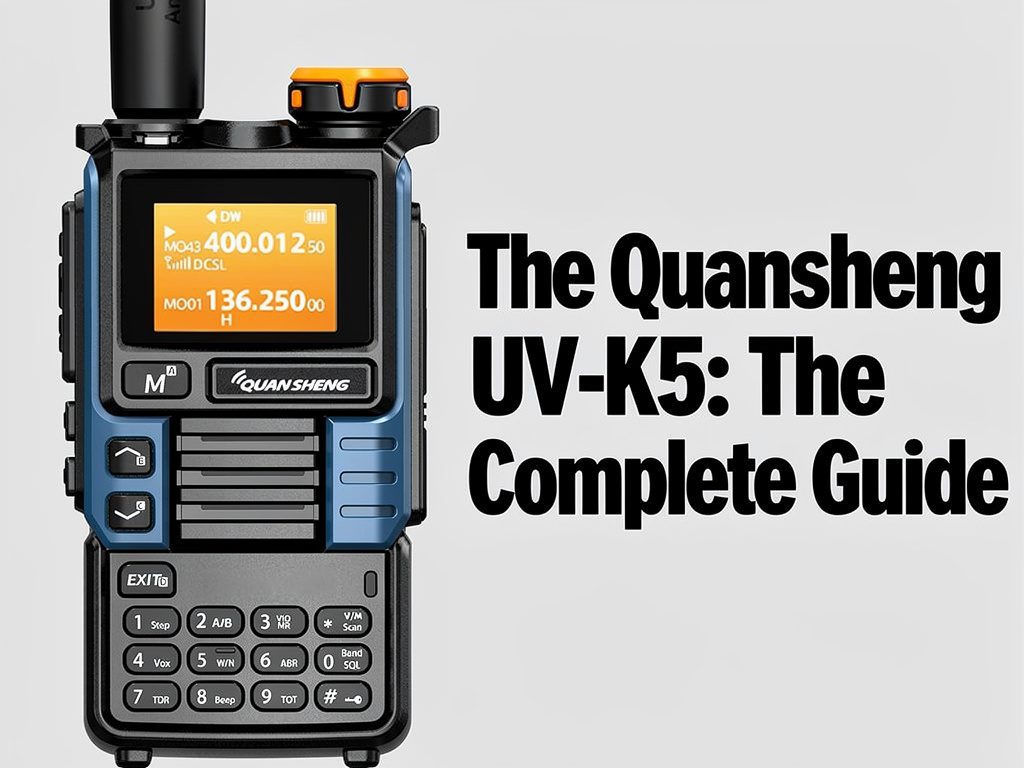
The Quansheng UV-K5 is a dual-band handheld transceiver that transmits on 2 meters and 70 centimeters, receives across a broad swath of the VHF and UHF spectrum, and retails for somewhere between twenty and thirty-five dollars depending on where you buy it. At that price it would be unremarkable — there have been cheap Chinese handhelds for years — except for one design decision that made it different from everything else in its class: Quansheng stored the firmware in external SPI flash memory rather than in the microcontroller’s internal ROM. That single architectural choice meant that any programmer with the right cable and the right curiosity could rewrite the radio’s brain entirely.
The amateur radio community noticed. Within months of the UV-K5’s 2023 release, a network of developers had reverse-engineered the original firmware, rebuilt it from scratch, and produced a succession of open-source replacements that turn a budget handheld into a genuinely capable experimenter’s platform. That ecosystem is the real reason to care about this radio.
This guide covers the hardware, the firmware landscape, how to flash it without destroying it, what the law actually says about transmitting on unlocked frequencies, what the radio does well in real use, and when you should spend more on something else.
Hardware: What’s Inside the Box
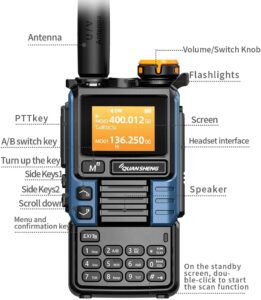
The UV-K5 is built around two key chips. The microcontroller is a DP32G030, a 32-bit ARM Cortex-M0+ running at 48 MHz. The RF section is handled by a BK4819 integrated transceiver, a single chip that manages both the VHF and UHF bands. The display is a 128×64 pixel monochrome LCD with a backlit dot-matrix layout. The battery is a 1,600 mAh lithium-ion pack at 7.2 volts, charged via USB-C or an optional desktop cradle. The antenna uses a male SMA connector on a 50-ohm impedance path. The whole radio weighs 234 grams and measures 60×115×38 mm.
The receiver sensitivity specification, per RigPix and Ham Imports technical data, is approximately 0.16 µV on VHF (136–470 MHz) for 12 dB SINAD, and 0.5 µV on AM in the 108–136 MHz airband range. Transmit power runs to nominally 5 watts on both bands, with mid and low settings also available; independent testing broadly confirms near-specification output on the VHF amateur band, though individual units vary.
The stock frequency coverage is worth stating precisely because marketing materials for the UV-K5 family routinely claim ranges that the hardware does not support in any meaningful way. What the radio actually covers in stock configuration is seven discrete receive bands: 50–76 MHz in FM, 108–136 MHz in AM (airband), 136–174 MHz in FM with transmit, 174–350 MHz in FM receive only, 350–400 MHz in FM receive only, 400–470 MHz in FM with transmit, and 470–600 MHz in FM receive only. FM broadcast reception (76–108 MHz) adds another band, and ten NOAA weather channels are included for US users. The claimed “20 to 1,000 MHz” range seen in some listings is a marketing stretch that does not reflect real sensitivity or selectivity across that span; outside the designed receive bands, the radio’s front end simply was not built for it.
Transmit authorization in stock configuration varies by regulatory region. US units are typically locked to 144–148 MHz on VHF and 420–450 MHz on UHF. European CE-marked units narrow further to 144–146 MHz and 430–440 MHz. General market units cover 136–174 MHz and 350–470 MHz. Custom firmware can unlock wider TX ranges, but that is a separate legal conversation addressed later in this guide.
Variants: K5, K5(8), K5(99), K6 — Are They Different Radios?
No. Multiple sources, including operators who have opened and compared PCBs across variants, confirm that the UV-K5, UV-K5(8), UV-K5(99), and UV-K6 share identical hardware. The same microcontroller, the same RF section, the same board layout. The variants differ cosmetically — button trim style, housing color, and the background color of the LCD backlight — but not electronically. When you buy any of them, you are buying the same radio in different clothes.
The UV-K5 hardware is also distributed under a long list of OEM brand names. Ham Imports’ documentation lists more than a dozen, including the Radtel RT-590, Retevis RA-79, Ruyage UV3D, and Weierwei UV-5R among others. FCC correspondence confirmed this arrangement officially. If you own one of those rebadged variants, everything in this guide applies.
Hardware revision warning (updated January 2026): Quansheng has released a version of the UV-K5 family with a different processor from the original. The radios look externally identical to earlier units. Flashing firmware compiled for the original DP32G030 onto a new-processor unit can brick it. Before you flash anything, verify your hardware revision and confirm that your chosen firmware explicitly supports it. This is covered in detail in the flashing section.
Stock Firmware: The Starting Point
The factory firmware, version 2.1.27 in the original release, is functional but constrained. It covers the standard amateur bands, supports CTCSS and DCS tone encoding, provides 200 memory channels, includes dual-watch scanning, DTMF, VOX, a flashlight mode, and FM broadcast receive. It is usable for basic repeater operation out of the box.
Its weaknesses are well-documented. AM reception — particularly on the airband — suffers from front-end saturation on strong signals, producing distorted audio. The scanning speed is slow by community standards. There is no spectrum analyzer, no SSB capability, no battery percentage display, and no way to remap the programmable buttons beyond the stock assignments. The menu system is functional but not refined.
The stock firmware is where most new owners start and where most stop. The custom firmware ecosystem is why the UV-K5 has become genuinely interesting.
The Custom Firmware Ecosystem
The open-source UV-K5 firmware scene began with DualTachyon’s reverse-engineered reimplementation of the stock firmware — a significant technical achievement that gave the community a buildable, modifiable foundation to work from. Everything that followed was built on that base.
The ecosystem today centers on a handful of active projects, each with different priorities and target audiences.
egzumer/uv-k5-firmware-custom is the dominant project for general users and the one most operators reach for first. It is a merge of several earlier contributions — DualTachyon’s open base, OneOfEleven’s interface and performance improvements, and fagci’s spectrum analyzer — with additional enhancements by the maintainer. As of the most recent confirmed release, v0.22, dated January 28, 2024, the repository shows 1,800 stars, 649 forks, and 655 commits. Given that the v0.22 release date is now more than two years old, readers should verify current release status directly at the GitHub repository before flashing, as additional releases may have occurred since this research was compiled.
fagci’s spectrum firmware was the original source of the spectrum analyzer capability that has since become a standard expectation in UV-K5 custom builds. As a standalone project it has been largely superseded, with its most important contributions absorbed into egzumer and other forks. It remains historically significant as the proof of concept that showed what the BK4819 chip could do in spectrum display mode.
OpenUVK5 takes a fundamentally different architectural approach. Rather than a single feature-rich firmware image, it is designed as a modular platform where capabilities are packaged as installable app-like modules that run on a lighter base firmware. In practice this makes it more attractive to developers and platform experimenters than to operators who want a polished daily-driver firmware. As of early-to-mid 2025, it was still in active but early-stage development, without a formal stable release series comparable to egzumer’s numbered versions.
IJV (IU0IJV/Fabrizio) is an independently developed firmware that the community frequently cites for strong receive performance — particularly on weak-signal work, SSB, and satellite passes. It is notable for being more closed-source than the rest of the ecosystem; the developer has not shared code in the way egzumer and others have. Community comparisons typically position egzumer as the more feature-complete and accessible option, while IJV is the choice when raw receive performance is the priority.
CEC firmware, developed by phdlee (hamskey.com), focuses on HF-adjacent capabilities — CW mode, SSB reception, and modes that complement the SI4732 hardware modification described later in this guide. It is niche but well-regarded among operators who bought the UV-K5 specifically as an HF receive platform.
kamilsss898 appears in community lists of UV-K5 firmware projects, but no confirmed stable release version has been found in the research gathered here. It should be treated as uncertain until verified directly from its repository.
The relationship between these projects is mostly collaborative rather than competitive. Developers build on each other’s work, port features across forks, and share diagnostic findings openly. The main practical tension is a code-size one: the radio’s flash memory imposes strict limits, which means no single firmware can include every feature every fork has developed. Every build involves trade-offs, and the compile-time options in egzumer’s Makefile are the mechanism for making those choices deliberately.
egzumer in Depth: What the Firmware Actually Does
Because egzumer is the firmware most operators encounter first and the one most thoroughly documented, it deserves a closer look at what it delivers in practice.
The AM fix is the single most impactful receive-side improvement. The stock radio’s AM demodulator saturates on strong signals — a hardware limitation in the BK4819 front end — producing distorted audio on anything from aircraft communications to medium-wave broadcast. The AM fix works by dynamically adjusting the front-end gain before saturation occurs. The result, described consistently by operators across reviews and forum posts, is dramatically improved AM intelligibility. The firmware’s own documentation acknowledges that at very strong signal levels the hardware eventually hits a ceiling that no software adjustment can overcome, but in normal use the improvement is substantial.
The spectrum analyzer, activated with the F and 5 keys, provides a real-time display of signal activity across a configurable frequency span on the radio’s 128×64 LCD. It is a genuinely useful field tool for scanning a band for activity, identifying interference sources, or getting a quick picture of what is happening in a given portion of the spectrum. It is not a substitute for a precision instrument like a TinySA — the resolution is limited, sweep speed varies, and the front end’s selectivity constrains its dynamic range — but for the price and size of the radio it is a remarkable capability. Version 0.21 added frequency-range scanning within the spectrum display, allowing the user to set lower and upper VFO boundaries for a targeted sweep.
SSB demodulation is available in egzumer, adopted from fagci’s earlier work. This is primarily a receive capability. The UV-K5’s transmit chain was not designed to produce clean SSB emissions, and using it as an SSB transmitter produces results the community consistently describes as technically poor due to harmonic content and filter limitations. As a receive tool for listening to HF SSB, satellite SSB telemetry, or weak-signal VHF/UHF work, it functions with reasonable usability.
Other meaningful improvements include fast scanning that moves through 200 channels in roughly four seconds rather than the stock rate, configurable long-press button functions, channel name editing directly from the menu, battery percentage display (selectable for either the stock 1,600 mAh battery or an upgraded 2,200 mAh replacement), backlight dimming with configurable levels, improved CTCSS/DCS scanning with a disabled timeout option, and an RSSI S-meter bar. The wide receive option (ENABLE_WIDE_RX in the Makefile) extends the receiver down to 18 MHz and up to 1,300 MHz — substantially beyond the hardware’s optimized range, and the repository’s own notes are candid that the front end and PA were not designed for the full span.
The firmware’s compile-time options table in the Makefile is worth studying before your first build. Feature categories range from stock Quansheng capabilities that can be disabled to recover flash space, through custom radio mods, to debugging options. The GitHub Codespace build method is the lowest-friction path for a first compile: it requires only a GitHub account and produces a downloadable firmware.packed.bin in a browser-based environment with no local toolchain setup.
Flashing: How to Do It, How Not to Break the Radio
The standard flashing setup is a two-pin Kenwood/K-plug style programming cable — the same connector the radio uses for audio and external mic/speaker — connected to a USB port via a serial adapter based on the CH340, FTDI, or similar chipset. On Windows, the CH340 driver typically needs to be installed manually. On Linux, the cable usually works without intervention.
To enter programming mode: power the radio off, hold the PTT button while powering it on, and confirm that the flashlight LED illuminates. That indicates the radio is waiting for a firmware transfer. Connect your programming cable, open your flashing tool, select the correct serial port, load your firmware file, and write.
Browser-based flashing tools are available and widely recommended for first-time users. The egzumer project hosts a web flasher that communicates with the radio through the browser’s serial interface, providing a progress display during the write. This approach sidesteps most driver-related issues and is simpler than some older desktop utilities.
The community’s consistent first-flash advice is: back up the stock firmware and calibration data before you write anything new. Most flashing tools support reading the existing image before overwriting it. Store that backup file somewhere you can find it. If something goes wrong, it is your recovery baseline.
The most common causes of a failed flash are using a cable with an incompatible or counterfeit chipset, an unstable USB connection during the write, flashing firmware compiled for the wrong hardware revision, and interrupting the process before it completes. The 2026 hardware revision — the one with the new processor — is the sharpest version of that last risk. A unit with the new processor running firmware compiled for the DP32G030 can be left in a non-functional state. Before flashing any unit purchased in 2025 or later, verify the hardware revision explicitly. Community documentation and firmware README files will specify supported hardware; if your unit’s revision is not listed, do not flash until you have confirmed compatibility.
Most bricked UV-K5s are recoverable. A radio that will not start after a bad flash can usually be brought back by re-entering programming mode and writing a known-good image from a reliable source. If the standard serial path is not available because the bootloader itself was affected, recovery is still possible using SWD (Serial Wire Debug) programming via an ST-LINK and OpenOCD, which accesses the chip at a lower level. This is a more involved process but has been documented in the community for cases where normal serial recovery fails.
True unrecoverable damage is uncommon and typically involves physical board damage rather than firmware issues. A bad flash is not a dead radio in most cases.
The Legal Reality
This section is written for licensed amateur operators. The answer to “is this legal” depends entirely on where you transmit, not on what the firmware can do.
On amateur frequencies, with your amateur license, you are on solid ground. The amateur radio service in the US — and its equivalents in most jurisdictions — explicitly permits operators to use home-built, modified, or otherwise non-type-accepted transmitters. Your FCC Part 97 license is a license to communicate on amateur frequencies, and the rules governing the amateur service do not require your transmitter to hold FCC equipment certification. You can flash egzumer, unlock wide receive, run the spectrum analyzer, and operate your UV-K5 on 2 meters and 70 centimeters with a clean conscience, provided you follow the rest of the rules that always apply to amateur operation: stay inside the amateur frequency allocations, keep your emissions within legal power and bandwidth limits, identify your station with your callsign, and remain the responsible control operator.
Outside amateur frequencies, the picture changes entirely. GMRS, FRS, and MURS are Part 95 services. They require FCC-certified equipment, and the certification is tied to the specific device in its original, unmodified configuration. When you flash custom firmware onto a UV-K5, you void whatever equipment authorization it held. An unlocked UV-K5 is not a legal GMRS radio, full stop — regardless of whether you hold a GMRS license, regardless of whether it can reach GMRS channels, and regardless of how the firmware labels those frequencies. The same applies to FRS and MURS. Using a modified UV-K5 on those services is operating unauthorized equipment, and the FCC has publicly addressed this pattern of Chinese handhelds operating outside their certified service in enforcement advisories and warnings.
Part 90 land-mobile is also certification-dependent. Commercial, public safety, and business-band land-mobile equipment must meet technical standards for its service. A UV-K5 running custom firmware does not qualify.
Wide receive is a different matter. Listening passively on frequencies you cannot legally transmit on does not carry the same legal exposure as transmitting. The FCC’s equipment authorization rules are primarily about transmitters. You can tune to anything the radio can receive without facing the same legal issue you would face by transmitting there.
The practical rule: transmit on amateur frequencies with your call. Keep the extended TX capability on a shelf. The wide receive is yours to use freely.
One additional consideration for operators in emergency communications groups: a modified UV-K5 does not carry valid type acceptance for public-safety or ARES/RACES operations that require certified equipment. It may work as a monitoring or receive-only tool in an emcomm context, but it is not a compliant primary transceiver for formal operations where equipment certification matters.
Power Output, AM/SSB Transmission, and Hardware Mods
The UV-K5’s transmit chain produces roughly 5 watts at high power on VHF, with independent tests broadly confirming near-specification output in the amateur bands. Firmware can select between power levels, but it cannot meaningfully increase the PA’s output beyond its hardware ceiling. The BK4819 chip’s internal PA operates within a defined range; firmware adjusts settings within that envelope.
Custom firmware can enable AM transmission and extended-frequency transmit in some builds. The community is candid about what this produces in practice: AM transmission from a radio whose PA chain was not designed for AM produces significant harmonic content and spurious emissions. This is not a firmware limitation — it is a hardware reality. The radio’s filtering is optimized for narrowband FM on the amateur bands. Transmitting in AM mode, or transmitting outside those bands on frequencies where the PA and filters were not characterized, produces emissions that are technically messy regardless of what the screen says. This is one of the reasons experienced operators caution against treating the extended TX unlock as a practical operating tool rather than an experimental curiosity.
The most significant hardware modification available for the UV-K5 is the SI4732 expansion board. The SI4732 is a Silicon Labs multi-band receiver chip that, when wired into the UV-K5, adds genuine HF receive coverage from roughly 0 to 30 MHz, plus the 64–108 MHz FM broadcast band. Combined with CEC or similar HF-capable firmware, this modification turns the radio into a functional HF scanner capable of AM, FM, LSB, USB, and CW on shortwave and medium wave. The expansion board is available from AliExpress for roughly £8–£13 (€10–€20), requires confident soldering, and is supported by installation videos. The frequency gap between approximately 26 MHz and 64 MHz in the SI4732’s datasheet-listed coverage is a noted limitation, though community reports suggest software may be able to address part of it.
M7MCQ’s real-world assessment of the modification is worth quoting directly: reception with the SI4732 board is “okay — not gold standard, but perfectly usable.” The audio is described as thin, the speaker adequate for normal conditions but strained in noisy environments. These are honest characterizations consistent with the radio’s price tier. With a good signal and the right firmware, the result is a remarkable HF scanner for what it costs. With a weak signal, it remains a cheap receiver.
A separate dual-antenna adapter board provides independent VHF and UHF antenna paths with integrated filtering — useful if you want to attach better antennas for specific monitoring tasks. External audio amplifier modules address the low audio output level that some SSB operators find limiting. These are community-designed add-ons rather than Quansheng products.
One specific caution about the SI4732 modification: multiple reports exist of purchasers buying UV-K5 units advertised as having the board pre-installed who discovered on opening the radio that it was not present. If you want the modification, either solder it yourself from a verified board or purchase from a source where you can inspect or file a complaint with consequence. AliExpress purchases of allegedly pre-modified units carry this risk.
Real-World Performance: What the Community Actually Says
The amateur radio community’s assessment of the UV-K5 is consistent across Reddit, eHam, YouTube, and ham blogs, and it can be summarized honestly in a single sentence: it is the best cheap Chinese handheld ever made, and it is still a cheap Chinese handheld.
Operators report that it performs well on local repeater work in areas without heavy RF congestion. The receiver sensitivity on VHF is adequate and sometimes better than comparably priced Baofeng competitors in side-by-side testing. The transmit audio, particularly with custom firmware applied, receives genuinely positive reviews — clearer and more natural than the UV-5R class for many operators. USB-C charging is a meaningful quality-of-life improvement over older Baofeng designs. The build quality is described as solid for the price, with less flex and creak than some competitors and surprising tolerance for rough handling.
The limitations are equally consistent. The internal speaker is weak by any objective measure — low volume, audible distortion under hard drive, and thin audio quality that makes noisy environments difficult. Selectivity is mediocre; in urban areas or near strong broadcast transmitters the front end can be overloaded in ways that more expensive radios handle gracefully. The 1,600 mAh battery is adequate for casual use — operators report eight to twelve hours on a typical transmit/receive/standby cycle — but not exceptional. Variable quality control across production batches means no two UV-K5s will perform identically.
The comparison to the Baofeng UV-5R is the natural reference point given the similar price and heritage. The community consensus is that the UV-K5 generally wins on build feel, charging convenience, firmware hackability, and airband reception capability. Neither radio is competitive with mid-tier Japanese equipment on any technical measure. Both are tools that work well enough when conditions are reasonable and reveal their compromises when conditions are not.
Battery life figures in some promotional materials reach extreme claims — one listing reviewed for this article mentioned 6,800 mAh, which is incorrect for the stock BPK-5 pack. The real battery is 1,600 mAh. Some operators use aftermarket extended-capacity batteries, and the firmware’s battery percentage calibration feature (selectable for 1,600 or 2,200 mAh packs) accommodates this.
The M7MCQ assessment from November 2024 captures the experiential reality well: the radio is a capable, usable HT for 2m and 70cm that you can leave in a glove box, take on a hike, use as a backup, or hand to someone just entering the hobby. It is not a primary radio for demanding work. The only criticism M7MCQ offers alongside consistent praise is the tuning method — the large rotary knob on top is volume only, and frequency changes require the up/down buttons. For operators accustomed to knob-based VFO tuning this is genuinely frustrating. It is a design choice Quansheng made that no firmware can change.
When to Skip It: Limitations and Step-Up Options
There are specific use cases where the UV-K5 is the wrong tool, and experienced operators are direct about naming them.
High-RF environments present serious problems. A crowded urban spectrum, operation near strong broadcast transmitters, or use alongside high-power repeater sites can overload the UV-K5’s front end in ways that make it nearly useless for reception. Radios with proper bandpass filtering and better front-end dynamic range handle these environments; the UV-K5 does not. If your operating environment has significant RF congestion, the UV-K5’s limitations will be visible on almost every contact.
Digital voice modes are simply not available. There is no DMR, no Yaesu System Fusion, no D-Star in any UV-K5 firmware. If your club, local emergency communications group, or regular nets have moved to digital voice, the UV-K5 cannot participate as a transmitting radio.
Formal emergency communications with equipment requirements will likely exclude a modified UV-K5 on certification grounds. As a receive-only monitor it may be useful in the field, but as a primary emergency transceiver it does not meet the equipment standards many organized groups require.
For operators ready to step up, the community’s recommendations cluster around a few options. The Yaesu FT-65R and FT-60R sit in the $110–$170 range and offer significantly better build quality, audio, and receiver performance with a long track record of reliability. For those who want digital voice alongside analog FM, the AnyTone AT-D878UV series (around $200) provides capable DMR with good analog performance. The Icom ID-52A and Yaesu FT-5DR occupy the premium handheld tier above $300 and provide the full package — digital voice, APRS capability, GPS, superior receive, and manufacturer support — for operators who need a serious primary radio. The UV-K5 makes a fine companion to any of those radios; it is rarely the right replacement for them.
The consensus framing from the community is: buy a UV-K5 to learn, experiment, explore firmware, practice antenna work, carry as a backup, and enjoy the genuine novelty of what a $25 radio can do when a community gets hold of it. Upgrade when you need reliability, digital modes, better receive performance under adverse conditions, or the assurance that your primary radio will work when the situation is serious.
A Note on Current Firmware Status
The most recent confirmed egzumer stable release in this research is v0.22, from January 2024. Given that this guide is being written in 2026, readers should check the egzumer GitHub repository directly for any releases after that date before deciding on a version to flash. The repository’s Releases section will show the current “Latest” tag and associated release notes.
The 2026 hardware revision with the new processor also has firmware compatibility implications that are still being worked out by the community. If you purchased a UV-K5 recently, the safest path is to verify your hardware revision before flashing, identify which firmware projects have explicitly confirmed support for your version, and follow the documentation for that specific build.
Conclusion
The Quansheng UV-K5 is interesting not because of what Quansheng built, but because of what the amateur radio community built on top of it. A 32-bit ARM microcontroller, an integrated RF transceiver, and external flash memory in a $25 package gave a global community of programmers and radio operators the raw material they needed. What came out the other side is a radio that does things no manufacturer would have put in its spec sheet: a real-time spectrum analyzer, SSB demodulation, a configurable button map, a battery voltage calibration menu, and the ability to receive from 18 MHz to 1,300 MHz with the wide receive option enabled.
It is still a cheap radio. Its front end overloads, its speaker is thin, and its selectivity is mediocre by any professional standard. It will not replace a Yaesu or an Icom. It is not the right radio for formal emergency communications, demanding weak-signal work, or digital voice operation.
What it is, honestly and usefully, is the best low-cost learning and experimenting platform the hobby has seen at its price point — and a surprisingly capable second or backup radio for everyday amateur use when conditions are reasonable and expectations are calibrated. At twenty-five dollars, the experiment costs very little if it doesn’t suit you. At twenty-five dollars with a functional spectrum analyzer and an AM demodulator that works, it is worth understanding properly before you decide.
Hardware specifications sourced from RigPix, Ham Imports, and manufacturer data. Firmware feature data sourced from the egzumer GitHub repository (github.com/egzumer/uv-k5-firmware-custom). Community performance assessments drawn from documented operator reviews and field reports. Version numbers should be verified against current GitHub releases before flashing.